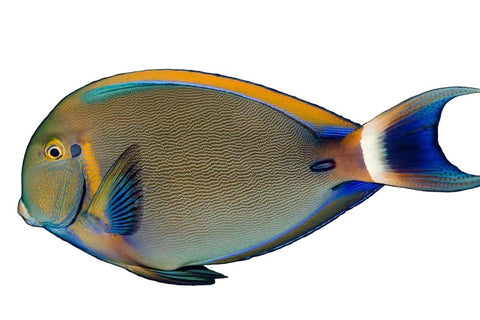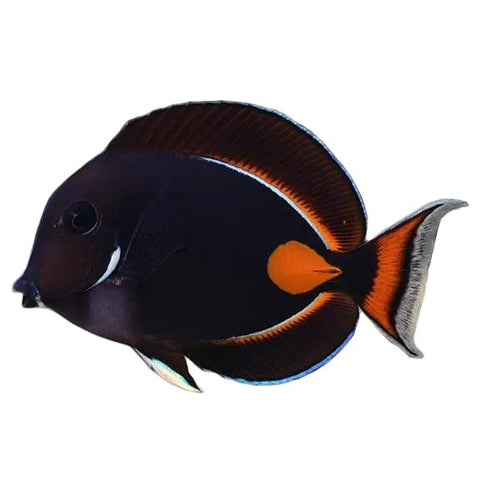
Achiles Tang
$1,800.00

Every fish passes through our dedicated quarantine system and strict biosecurity monitoring before sale - so it arrives healthy, settled and ready to thrive. How we quarantine →
| Tasmania | YES |
| Western Australia | YES |
| Northern Territory | NO |
| All Other States | YES |
The Red Coris Wrasse is a spectacular and highly active wrasse famous for its dramatic colour transformation as it matures. Juveniles display a vivid red-orange body with distinctive white saddles outlined in black, while adults develop a blue-green body covered in bright blue spots, a yellow tail and colourful facial markings.
This is a large, powerful wrasse that can reach around 40 cm in the wild. It spends much of its time exploring the aquarium, turning over rubble and searching for small crustaceans and other prey.
A deep, soft sand bed is essential because Red Coris Wrasses bury themselves in the sand to sleep and when frightened. Fine sand is strongly preferred over crushed coral or sharp substrates.
Although they generally leave corals alone, their hunting and rock-moving behaviour means they are not suitable for aquariums containing ornamental shrimp, crabs and other small invertebrates.
Scientific Name: Coris gaimard
Common Name: Red Coris Wrasse / Yellowtail Coris / Clown Wrasse
Family: Labridae
Type: Marine Fish / Wrasse
Adult Size: Up to approximately 40 cm
Temperament: Semi-Aggressive
Care Level: Intermediate
Minimum Aquarium: 500 L+
Temperature: 24–28°C
pH: 8.0–8.4
Salinity: 1.023–1.026 SG
Diet: Carnivore
Tank Level: All Levels / Sand & Rockwork
Reef Safe: With Caution
Suitable For: Large mature marine aquariums and FOWLR systems
They can reach around 40 cm, making them one of the larger commonly kept wrasses.
Red Coris Wrasses undergo an incredible colour transformation. Juveniles are predominantly red-orange with black-edged white markings, while adults develop blue-green colouration, blue spots and a yellow tail.
Yes. A deep bed of fine, soft sand is essential for sleeping and hiding. A depth of roughly 7–10 cm or more is commonly recommended.
They generally don't eat coral polyps, but they will actively hunt shrimp, crabs, snails, worms and other small invertebrates. Their digging and rock-moving behaviour can also disturb corals. They are therefore best considered reef safe with caution.
They are carnivores and readily accept mysis shrimp, brine shrimp, prawns, chopped seafood, krill and quality marine pellets.
Yes. Like many wrasses, they can be excellent jumpers, so a secure aquarium lid or mesh cover is recommended.
Keeping one without a deep sand bed
This is one of the most important requirements. They need somewhere to completely bury themselves.
Using crushed coral as substrate
Sharp or coarse substrate can cause injuries when the wrasse burrows.
Buying a tiny juvenile without considering its adult size
That colourful little juvenile can eventually become a 40 cm fish.
Keeping ornamental shrimp or crabs
Their natural hunting behaviour puts small crustaceans at considerable risk.
Allowing unstable rockwork
Red Coris Wrasses can move rubble and disturb rockwork while hunting, potentially knocking over corals.
Leaving the aquarium uncovered
They can jump, particularly when newly introduced or startled.
Underfeeding
They are active carnivores and benefit from regular feeding, particularly as they grow.
Livestock is dispatched with heat/cool packs and oxygen from our Melbourne facility, timed for the safest transit. Live arrivals may be scheduled for the best shipping window. A live arrival guarantee applies - contact us within the required window if anything is not right.
We stand behind everything we sell. If something is not right, get in touch and we will make it right. See our returns policy for the details.
This fish has been through our dedicated quarantine system and is feeding, settled and health-checked before sale. We still recommend acclimating slowly and quarantining new additions at home. Our team is happy to talk you through the right setup - just ask.