Sold out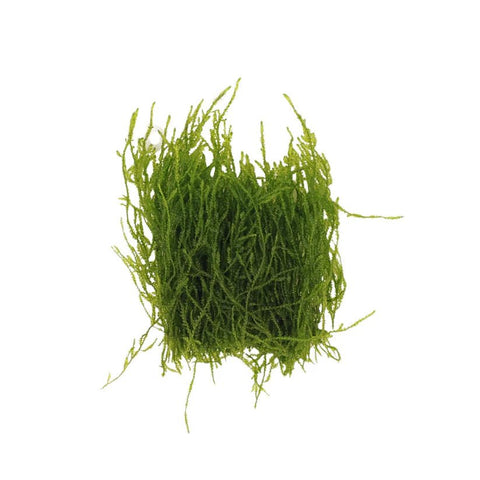

Moss
From $15.00

| Tasmania | NO |
| Western Australia | NO |
| Northern Territory | NO |
| All Other States | YES |
Limnophila Vietnam is a beautiful and distinctive freshwater aquarium plant prized for its delicate, narrow leaves and attractive star-shaped growth tips. Its bright green foliage adds fine texture and depth to planted aquariums, making it a popular choice for detailed aquascaping.
Unlike traditional upright stem plants, Limnophila Vietnam can develop a creeping growth habit under strong lighting, spreading horizontally to create attractive low-growing bushes and ground cover. This makes it particularly useful for foreground and midground planting, especially around rocks, driftwood and decorative hardscape.
Under moderate lighting, the plant generally grows more upright, forming compact clusters of delicate green stems. With stronger lighting and suitable growing conditions, the central veins and stems can develop attractive reddish tones, adding further visual interest.
Limnophila Vietnam performs best in nutrient-rich conditions with consistent fertilisation. While it can be maintained without injected CO2, additional CO2 supplementation is highly recommended for stronger growth, improved density and more reliable creeping development.
Regular trimming helps maintain its compact shape and encourages branching. Healthy cuttings can be replanted into the substrate to establish new growth, allowing the plant to gradually form thicker groups.
This plant is particularly suited to aquascaping styles that feature natural stone arrangements, planted slopes and detailed foreground transitions. Its delicate foliage creates a beautiful contrast against broader-leaved aquarium plants.
|
Care Information |
Details |
|---|---|
|
Scientific Name |
Limnophila sp. 'Vietnam' |
|
Family |
Plantaginaceae |
|
Origin |
Vietnam / Southeast Asia (trade designation) |
|
Plant Type |
Stem plant |
|
Care Level |
Moderate |
|
Growth Rate |
Moderate to Fast |
|
Expected Height |
Approximately 5–15 cm |
|
Placement |
Foreground to midground |
|
Lighting |
Medium to High |
|
Temperature |
20–27°C |
|
pH |
4.5–7.0 |
|
GH |
Soft to moderately hard water |
|
KH |
0–7 dKH |
|
CO2 |
Recommended |
|
Fertilisation |
Regular liquid fertiliser and nutrient-rich substrate |
|
Propagation |
Stem cuttings and runners |
|
Aquarium Type |
Freshwater planted aquarium |
1. Does Limnophila Vietnam require CO2?
CO2 is not strictly essential for survival, but supplementation is strongly recommended for compact growth, dense foliage and creeping development.
2. Can Limnophila Vietnam grow as a carpet?
Yes. Under strong lighting and suitable CO2 and nutrient conditions, it can develop creeping shoots and form low-growing ground cover.
3. How tall does Limnophila Vietnam grow?
It generally remains around 5–15 cm under suitable conditions, although growth height depends on lighting and trimming.
4. Why is my Limnophila Vietnam growing upwards instead of spreading?
Insufficient lighting is a common reason. Stronger lighting, suitable CO2 levels and regular trimming can encourage more compact, horizontal growth.
5. Does Limnophila Vietnam need a nutrient-rich substrate?
A nutrient-rich substrate can support healthy growth, although regular water-column fertilisation is also important.
6. How do you propagate Limnophila Vietnam?
Healthy stem cuttings can be replanted directly into the substrate. Under suitable conditions, the plant can also spread through creeping shoots.
1. Insufficient lighting: Low light encourages taller, less compact growth rather than the desired creeping habit.
2. Expecting carpeting without CO2: Although possible to grow without injected CO2, achieving dense ground cover is considerably more difficult.
3. Neglecting fertilisation: Insufficient nutrients can result in weak growth and deteriorating foliage.
4. Allowing overcrowding: Dense growth can shade lower shoots and reduce healthy development.
5. Infrequent trimming: Regular pruning encourages branching and helps maintain an attractive compact shape.
6. Unstable water conditions: Sudden changes in temperature and water chemistry can stress the plant and interrupt new growth.
Dispatched from our Melbourne facility, usually within 1-2 business days. Delivery time and cost are calculated at checkout based on your address.
We stand behind everything we sell. If something is not right, get in touch and we will make it right. See our returns policy for the details.


