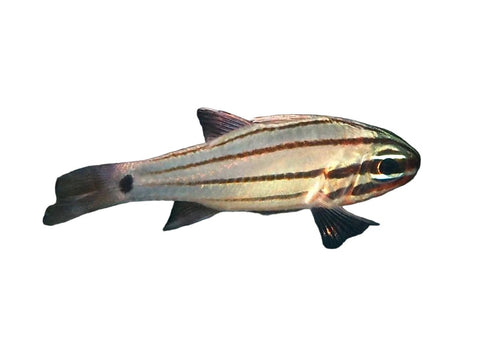
4 Lined Cardinal
$30.00

Every fish passes through our dedicated quarantine system and strict biosecurity monitoring before sale - so it arrives healthy, settled and ready to thrive. How we quarantine →
| Tasmania | YES |
| Western Australia | YES |
| Northern Territory | NO |
| All Other States | YES |
The Yellow-Flanked Fairy Wrasse is a colourful and active reef fish recognised for its blue-green and purple tones, orange to pink body and vivid yellow-orange colouration along the flanks. Males develop stronger colours and more impressive fin displays, particularly during courtship and territorial displays. Cirrhilabrus cyanopleura is also commonly known as the Blueside Wrasse or Blue-scaled Fairy Wrasse.
This peaceful fairy wrasse spends much of its time swimming through the midwater and upper areas of the aquarium, picking small zooplankton from the water column. It is an excellent choice for a mature reef aquarium and will generally leave corals and larger ornamental invertebrates alone.
Yellow-Flanked Fairy Wrasses are protogynous hermaphrodites, meaning individuals begin life as females and the dominant individual can transition into a male. They can be kept individually or as a male with several females in a suitably sized aquarium.
As with other fairy wrasses, a secure lid or mesh cover is strongly recommended, as they are capable jumpers.
Scientific Name: Cirrhilabrus cyanopleura
Common Name: Yellow-Flanked Fairy Wrasse / Blueside Wrasse / Blue-scaled Fairy Wrasse
Family: Labridae
Type: Marine Fish / Fairy Wrasse
Adult Size: Approximately 12–13 cm
Temperament: Peaceful to Semi-Aggressive
Care Level: Easy to Intermediate
Minimum Aquarium: 200 L+
Temperature: 24–28°C
pH: 8.0–8.4
Salinity: 1.023–1.026 SG
Diet: Carnivore / Planktivore
Tank Level: Midwater to Upper Levels
Reef Safe: Yes
Suitable For: Reef aquariums and peaceful marine communities
Yes. They are generally considered reef safe and are excellent additions to coral reef aquariums.
They can reach approximately 12–13 cm as adults.
They naturally feed on zooplankton in the water column. In captivity, offer mysis shrimp, enriched brine shrimp, copepods, chopped seafood and quality marine pellets. Several smaller meals throughout the day are beneficial.
Yes. A single male with several females can work well in a suitably sized aquarium. Multiple males may compete and display territorial behaviour.
Yes. Fairy wrasses are protogynous hermaphrodites. If the dominant male disappears, a dominant female can transition into a male.
Yes. A tight-fitting lid or mesh cover is strongly recommended.
Leaving the aquarium uncovered
Fairy wrasses are excellent jumpers and can escape through surprisingly small gaps.
Keeping multiple males in a small aquarium
Males may compete aggressively for dominance.
Feeding only once per day
Their active planktivorous lifestyle is better supported by several smaller meals.
Keeping them with aggressive fish
Their relatively peaceful temperament makes them vulnerable to harassment.
Not providing enough swimming space
They spend much of their time in the water column and benefit from open swimming areas.
Adding one to an immature aquarium
A mature, stable reef system is preferable for long-term success.
Livestock is dispatched with heat/cool packs and oxygen from our Melbourne facility, timed for the safest transit. Live arrivals may be scheduled for the best shipping window. A live arrival guarantee applies - contact us within the required window if anything is not right.
We stand behind everything we sell. If something is not right, get in touch and we will make it right. See our returns policy for the details.
This fish has been through our dedicated quarantine system and is feeding, settled and health-checked before sale. We still recommend acclimating slowly and quarantining new additions at home. Our team is happy to talk you through the right setup - just ask.

Choose type