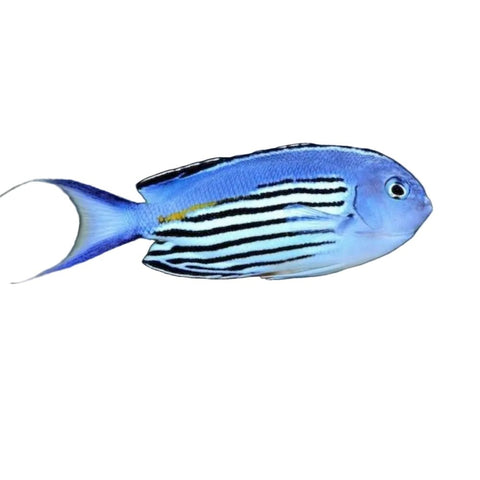
Watanabe Angelfish (Male)
$300.00

Every fish passes through our dedicated quarantine system and strict biosecurity monitoring before sale - so it arrives healthy, settled and ready to thrive. How we quarantine →
| Tasmania | YES |
| Western Australia | YES |
| Northern Territory | NO |
| All Other States | YES |
The Japanese Masked Angel (Genicanthus semifasciatus), also known as the Japanese Swallowtail Angelfish or Masked Swallowtail Angelfish, is a spectacular marine angelfish prized for its elegant body shape, distinctive markings and peaceful temperament.
Unlike many other angelfish, this species belongs to the genus Genicanthus, a group of predominantly open-water swimming angelfish known for their flowing fins and plankton-feeding behaviour. This makes the Japanese Masked Angel particularly attractive to reef aquarists looking for a larger angelfish that is generally compatible with corals.
One of its most interesting characteristics is its dramatic sexual dimorphism, with males and females displaying noticeably different colour patterns.
Appearance and Natural Habitat
Male Japanese Masked Angels display a yellow-orange face and upper body, with numerous narrow, wavy dark vertical markings across the upper sides. Females have a more subdued grey-brown and white appearance, with distinctive dark markings around the head and tail.
Both sexes have an elegant, elongated body and a characteristic swallowtail-shaped caudal fin.
Native to the Western Pacific, this species occurs from southern Japan through Taiwan to the northern Philippines. It inhabits seaward rocky and coral reefs, generally at depths of approximately 15–100 metres.
Behaviour and Temperament
The Japanese Masked Angel is generally peaceful and spends much of its time swimming in open water above the reef structure, searching for planktonic food.
Unlike many dwarf and large angelfish species, it is not strongly associated with grazing directly on coral surfaces. It is a naturally social species that forms groups consisting of one dominant male and several females.
An interesting biological characteristic is that it is a protogynous hermaphrodite, meaning individuals initially develop as females and can change sex to become males. In suitable social groups, the largest or dominant female may eventually transition into a male.
Aquarium Suitability and Compatibility
The Japanese Masked Angel is an excellent candidate for larger, established reef aquariums. Its peaceful nature makes it suitable for communities containing tangs, clownfish, anthias, wrasses, gobies and other compatible marine species.
Provide plenty of open swimming space, good water movement and established live rock for shelter.
Although generally peaceful, it may compete with other open-water planktivores for food. Avoid keeping it with highly aggressive angelfish or fish that prevent it from feeding comfortably.
Reef Compatibility
One of the major advantages of the Japanese Masked Angel is its reputation as a reef-safe angelfish.
Unlike many other angelfish, Genicanthus species are specialised planktivores and generally leave corals, clams and other sessile invertebrates alone.
This makes the Japanese Masked Angel an excellent option for aquarists wanting to keep an angelfish in a coral-rich aquarium without the same coral-nipping risks associated with many other angelfish species.
Feeding and Nutrition
Japanese Masked Angels are primarily planktivores, feeding on small floating organisms and zooplankton in the water column.
In captivity, they generally accept a variety of frozen and prepared marine foods.
Suitable foods include:
Frozen mysis shrimp.
Enriched brine shrimp.
Calanus and other zooplankton.
Quality marine pellets.
Finely chopped marine seafood.
Spirulina-enriched marine preparations.
Offer small meals two to three times daily to support their active swimming behaviour and nutritional requirements.
Specific Care Requirements
The Japanese Masked Angel is best maintained in a mature marine aquarium with stable water conditions, excellent filtration and sufficient swimming space.
Because this species naturally inhabits deeper reef environments, it can appreciate shaded areas and moderate lighting, although it should not be kept in an aquarium with inadequate water quality or oxygenation.
A secure aquarium cover is recommended, particularly during acclimatisation.
With suitable tankmates, regular feeding and stable water parameters, the Japanese Masked Angel can become a stunning centrepiece in a large marine or reef aquarium.
|
Care Requirement |
Details |
|---|---|
|
Scientific Name |
Genicanthus semifasciatus |
|
Common Names |
Japanese Swallowtail Angel, Japanese Masked Angel |
|
Family |
Pomacanthidae |
|
Origin |
Southern Japan, Taiwan and northern Philippines |
|
Care Level |
Moderate |
|
Adult Size |
Approximately 21 cm |
|
Minimum Aquarium Size |
500 litres |
|
Temperature |
24–27°C |
|
pH |
8.1–8.4 |
|
Salinity |
1.023–1.026 SG |
|
Diet |
Omnivore / Planktivore |
|
Feeding Frequency |
2–3 times daily |
|
Temperament |
Peaceful |
|
Swimming Level |
Middle and upper water column |
|
Reef Compatibility |
Reef Safe |
|
Aquarium Type |
Large marine and reef aquariums |
|
Social Behaviour |
Individual, pairs or harem groups |
Note: Aquarium volume is a practical recommendation, with larger systems preferred for adult specimens and groups.
1. Is the Japanese Masked Angel reef safe?
Yes. Unlike many angelfish, Japanese Masked Angels are primarily plankton feeders and generally leave corals, clams and other sessile invertebrates alone.
2. What is the difference between male and female Japanese Masked Angels?
Males have a yellow-orange face and distinctive dark wavy vertical markings across the upper body. Females have a more subdued grey and white appearance with dark markings around the head and tail.
3. Can Japanese Masked Angels be kept in pairs?
Yes. They can be maintained as compatible pairs or in larger harem groups consisting of one male and several females. Allow sufficient aquarium space and monitor compatibility.
4. What do Japanese Masked Angels eat?
They primarily feed on zooplankton. Suitable aquarium foods include mysis shrimp, enriched brine shrimp, calanus, marine pellets and other quality frozen marine foods.
5. How big does a Japanese Masked Angel grow?
Adults can reach approximately 21 cm in total length. They are active swimmers and need considerably more swimming space than their juvenile size might suggest.
6. Can Japanese Masked Angels change sex?
Yes. This species is a protogynous hermaphrodite. Individuals initially develop as females and can transition into males when social conditions and dominance hierarchy allow.
1. Keeping them in undersized aquariums: These are active swimming angelfish that require considerable open swimming space. Plan for their adult size rather than their purchase size.
2. Providing an inadequate diet: A diet consisting exclusively of flakes or pellets may not provide sufficient variety. Include frozen zooplankton and other nutritious marine foods.
3. Keeping them with aggressive tankmates: Their peaceful temperament makes them vulnerable to harassment from larger, territorial marine fish.
4. Overlooking their social behaviour: Males can establish dominance within groups. Carefully plan the introduction of multiple specimens.
5. Insufficient feeding frequency: As active planktivores, they benefit from multiple smaller meals throughout the day.
6. Introducing them into unstable aquariums: Maintain mature biological filtration, consistent salinity and excellent water quality before introduction.
Livestock is dispatched with heat/cool packs and oxygen from our Melbourne facility, timed for the safest transit. Live arrivals may be scheduled for the best shipping window. A live arrival guarantee applies - contact us within the required window if anything is not right.
We stand behind everything we sell. If something is not right, get in touch and we will make it right. See our returns policy for the details.
This fish has been through our dedicated quarantine system and is feeding, settled and health-checked before sale. We still recommend acclimating slowly and quarantining new additions at home. Our team is happy to talk you through the right setup - just ask.