Biosecurity Shipping Limitations apply
Shipping Allowed?
| Tasmania |
NO |
| Western Australia |
NO |
| Northern Territory |
NO |
| All Other States |
YES |
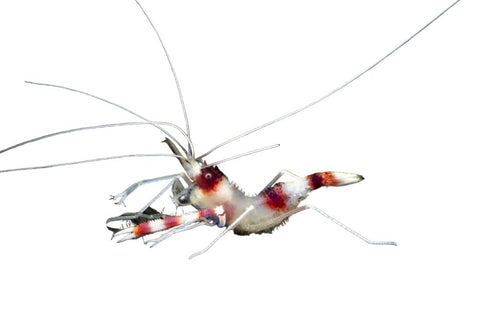
The Bald Shrimp (Alope orientalis), also known as the Bald Prawn or Oriental Reef Shrimp, is a small and unusual marine shrimp found throughout the Indo-Pacific, including the southern and eastern coastlines of Australia.
Growing to approximately 3 cm in length, this fascinating little crustacean is an interesting addition to specialist marine aquariums, particularly for hobbyists who appreciate smaller, less commonly available invertebrates.
Its slender, semi-translucent body can display mottled reddish, brown, greenish and pale colouration, often with attractive white flecks and contrasting bands across its legs. One of its most distinctive features is a noticeable pale stripe across the base of the tail fan.
Appearance and Natural Habitat
The Bald Shrimp has a relatively elongated body, delicate legs and long antennae. Its rostrum, the pointed extension at the front of its head, is slightly longer than its eyestalks and typically has four to seven teeth along its upper edge.
It naturally inhabits shallow coastal environments, including rocky reefs, tidal pools, seaweed beds and seagrass meadows. It can also be found at depths reaching approximately 46 metres.
Its natural distribution includes southern and eastern Australia and extends throughout the wider Indo-Pacific.
Behaviour and Temperament
The Bald Shrimp is a small, generally peaceful crustacean that spends much of its time exploring surfaces and searching for food.
It feeds on algae and scavenges for small amounts of animal matter, helping it make use of naturally occurring food sources within its environment.
Its small claws are unlikely to cause problems for aquarium inhabitants, making it an interesting candidate for carefully selected marine invertebrate communities.
Because of its small size, however, it should be protected from larger predatory fish and invertebrates that may consume it.
Aquarium Suitability and Compatibility
The Bald Shrimp is best suited to established marine aquariums containing live rock, natural algae growth and plenty of small crevices.
Its tiny size makes it particularly interesting for nano marine systems and specialist invertebrate aquariums, provided water quality remains stable.
Suitable tankmates include peaceful small marine fish and other non-predatory invertebrates. Avoid aggressive fish, larger predatory shrimp and species that may view it as food.
Provide plenty of rockwork, seaweed and other natural surfaces where it can graze and retreat when disturbed.
Reef Compatibility
The Bald Shrimp is considered a potentially suitable addition to peaceful reef aquariums. Its natural diet consists primarily of algae and scavenged organic matter rather than coral tissue.
Its small claws are unlikely to pose a significant threat to corals or larger aquarium inhabitants. However, its exact interactions with ornamental corals and other invertebrates in captivity are not extensively documented.
Feeding and Nutrition
The Bald Shrimp is an omnivorous grazer and scavenger that naturally feeds on algae and small amounts of animal matter.
In captivity, it should benefit from a combination of naturally occurring biofilm and supplementary foods.
Suitable foods include:
-
Marine algae and biofilm.
-
Fine-quality marine shrimp pellets.
-
-
Finely crushed marine flakes.
-
Small amounts of frozen mysis shrimp.
-
Fine particulate marine invertebrate foods.
Feed small quantities and allow the shrimp to graze naturally between supplementary feedings. Avoid overfeeding, particularly in smaller aquariums.
Specific Care Requirements
The Bald Shrimp is a relatively small marine invertebrate that benefits from stable water chemistry, good oxygenation and an established aquarium environment.
Provide plenty of live rock and natural grazing surfaces. Gentle to moderate water movement will help maintain oxygen levels while allowing the shrimp to explore comfortably.
As with other crustaceans, stable mineral availability is important for successful moulting. Avoid sudden changes in salinity and temperature, and ensure that aquarium treatments are safe for marine invertebrates.
Its small size and unusual appearance make it a particularly interesting addition to specialist marine aquariums.
Quick Care Guide
|
Care Requirement
|
Details
|
|
Scientific Name
|
Alope orientalis
|
|
Common Names
|
Bald Shrimp, Bald Prawn, Oriental Reef Shrimp
|
|
Family
|
Hippolytidae
|
|
Origin
|
Indo-Pacific, including southern and eastern Australia
|
|
Care Level
|
Moderate
|
|
Adult Size
|
Approximately 3 cm
|
|
Minimum Aquarium Size
|
30 litres recommended
|
|
Temperature
|
22–26°C, subject to collection origin
|
|
pH
|
8.1–8.4
|
|
Salinity
|
1.023–1.026 SG
|
|
Diet
|
Omnivore / Algae grazer
|
|
Feeding Frequency
|
Small supplementary feeds as required
|
|
Temperament
|
Peaceful
|
|
Swimming Level
|
Bottom and rock surfaces
|
|
Reef Compatibility
|
Generally Reef Compatible
|
|
Aquarium Type
|
Marine reef and invertebrate aquariums
|
|
Natural Habitat
|
Reefs, seaweed beds and seagrass meadows
|
|
Maximum Recorded Depth
|
Approximately 46 metres
|
Note: Aquarium volume and water parameters are suggested husbandry starting points. Species-specific captive-care requirements have not been extensively documented.
Museum Victoria Collections+2
Frequently Asked Questions
1. How big does a Bald Shrimp grow?
The Bald Shrimp is a very small species, reaching approximately 3 cm in total length. Its compact size makes it particularly interesting for smaller marine aquariums.
2. Is the Bald Shrimp reef safe?
It is generally considered suitable for peaceful reef aquariums. Its natural diet consists of algae and scavenged organic matter rather than coral tissue.
3. What does a Bald Shrimp eat?
It is an omnivore that grazes on algae, biofilm and small amounts of animal matter. Supplement its natural grazing with fine shrimp foods, spirulina and small frozen foods.
4. Can Bald Shrimp be kept with other shrimp?
Yes, they can potentially be maintained alongside peaceful, similarly sized marine invertebrates. Avoid aggressive or predatory shrimp species that may attack smaller crustaceans.
5. Where does the Bald Shrimp naturally live?
It occurs throughout the Indo-Pacific, including southern and eastern Australia. It inhabits rocky reefs, tidal pools, seaweed beds and seagrass meadows.
6. Is the Bald Shrimp suitable for nano aquariums?
Its small adult size makes it an interesting candidate for nano marine aquariums. However, stable water conditions, adequate filtration and sufficient natural grazing surfaces are essential.
Common Mistakes
1. Keeping it with predatory fish: Its small size makes it vulnerable to larger fish that naturally feed on crustaceans. Choose tankmates carefully.
2. Introducing it into an immature aquarium: Established live rock and natural biofilm provide valuable grazing opportunities.
3. Providing insufficient food: Although it scavenges naturally, it may require supplementary feeding in clean aquariums with limited algae growth.
4. Allowing water parameters to fluctuate: Sudden changes in salinity, temperature and water chemistry can cause stress and moulting complications.
5. Using copper-based treatments: Copper-containing medications can be toxic to shrimp and other marine invertebrates. Always check treatment compatibility.
6. Overfeeding: Excess food can quickly deteriorate water quality, particularly in smaller marine systems. Feed small amounts and remove uneaten food.