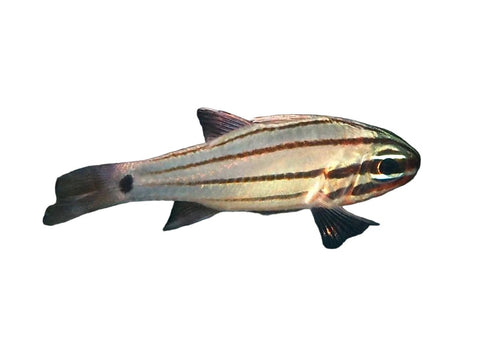
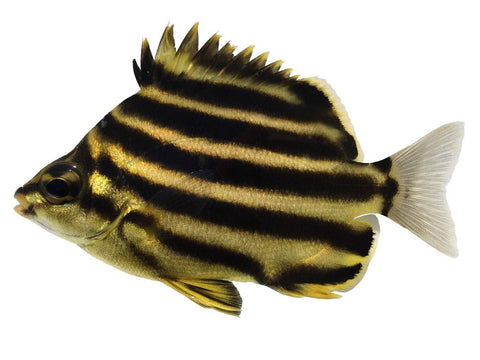
4 Lined Cardinal
$30.00

Every fish passes through our dedicated quarantine system and strict biosecurity monitoring before sale - so it arrives healthy, settled and ready to thrive. How we quarantine →
| Tasmania | YES |
| Western Australia | YES |
| Northern Territory | NO |
| All Other States | YES |
The Stars and Stripes Pufferfish is a spectacular large marine puffer recognised for its cream to grey body covered in dark spots, lines and star-like markings. Its expressive face and bold pattern make it a fascinating feature fish for a large marine aquarium.
This species is intelligent, curious and highly interactive, often learning to recognise its keeper and investigating everything introduced into the aquarium. It is a predatory species with powerful teeth and should be housed with robust tank mates that can handle its personality.
Stars and Stripes Puffers require a spacious aquarium with plenty of swimming room and rockwork to explore. Their diet should include hard-shelled foods such as mussels, clams, shell-on shrimp and snails, which help provide natural dental wear.
They are not considered reef safe, as they may consume crustaceans, molluscs and other ornamental invertebrates and can damage or eat corals.
Scientific Name: Arothron hispidus
Common Name: Stars and Stripes Pufferfish / White-Spotted Puffer
Family: Tetraodontidae
Type: Marine Fish / Pufferfish
Adult Size: Up to approximately 45 cm
Temperament: Semi-Aggressive
Care Level: Intermediate to Advanced
Minimum Aquarium: 500 L+
Temperature: Approximately 24–28°C
pH: Approximately 8.1–8.4
Salinity: Approximately 1.020–1.026 SG
Diet: Carnivore / Molluscivore
Tank Level: All Levels
Reef Safe: No
Suitable For: Large Fish-Only Marine Aquariums
No. It is not reef safe. It may eat shrimp, crabs, snails, clams and other invertebrates and may also damage corals.
This species can reach approximately 45 cm, making its eventual adult size an important consideration when planning an aquarium.
Offer a varied carnivorous diet including mussels, clams, shell-on shrimp, snails, squid and other meaty marine foods. Hard-shelled foods are particularly important for natural tooth wear.
They are generally semi-aggressive and can become territorial or bite tank mates. They are best kept with appropriately sized, robust fish.
Yes, in a sufficiently large fish-only aquarium with carefully selected tank mates. Avoid small, slow-moving or delicate fish and monitor interactions closely.
Yes. Pufferfish have powerful dental plates that continuously grow. Regularly offering hard-shelled foods helps keep their teeth naturally worn down.
Keeping one in a reef aquarium
Their natural diet includes many of the invertebrates commonly kept in reef tanks.
Underestimating their adult size
A juvenile may look suitable for a smaller aquarium, but adults become very large.
Feeding only soft foods
Regular hard-shelled foods are important for maintaining healthy teeth.
Keeping delicate tank mates
Puffers can nip or attack smaller and slower fish.
Poor filtration
Large puffers produce significant waste. Strong biological and mechanical filtration is essential.
Handling the fish unnecessarily
Pufferfish should not be intentionally exposed to air or handled unless absolutely necessary, as this can cause significant stress.
Livestock is dispatched with heat/cool packs and oxygen from our Melbourne facility, timed for the safest transit. Live arrivals may be scheduled for the best shipping window. A live arrival guarantee applies - contact us within the required window if anything is not right.
We stand behind everything we sell. If something is not right, get in touch and we will make it right. See our returns policy for the details.
This fish has been through our dedicated quarantine system and is feeding, settled and health-checked before sale. We still recommend acclimating slowly and quarantining new additions at home. Our team is happy to talk you through the right setup - just ask.
Choose type