Sold out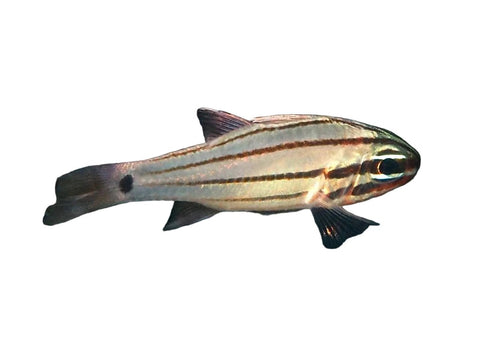
4 Lined Cardinal
$30.00

Every fish passes through our dedicated quarantine system and strict biosecurity monitoring before sale - so it arrives healthy, settled and ready to thrive. How we quarantine →
| Tasmania | YES |
| Western Australia | YES |
| Northern Territory | NO |
| All Other States | YES |
The Bi-Colour Parrotfish (Cetoscarus ocellatus) is a large and striking marine fish found throughout the tropical Indo-Pacific, including parts of Australia's Great Barrier Reef and Western Australian reefs.
This species undergoes dramatic colour changes as it matures. Juveniles have a distinctive white body with a bright orange band across the head and a prominent black spot on the dorsal fin. Females develop darker reddish-brown and pale yellow markings, while mature males display spectacular green and pink colouration.
Like other parrotfish, it has powerful fused teeth that form a beak-like mouth. It uses this specialised mouth to graze on algae and bite into reef surfaces, consuming algae and some living coral tissue in the process.
The Bi-Colour Parrotfish is an active swimmer that needs substantial open swimming space, plenty of grazing surfaces and a mature marine environment. It is not suitable for most home aquariums due to its eventual size and feeding behaviour.
Important: This species is sometimes listed under the older trade name Cetoscarus bicolor. In Australian waters, the recognised species is Cetoscarus ocellatus; Cetoscarus bicolor is now considered restricted to the Red Sea.
|
Care Requirement |
Details |
|---|---|
|
Scientific Name |
Cetoscarus ocellatus |
|
Family |
Scaridae |
|
Origin |
Indo-Pacific, including Australia |
|
Care Level |
Expert |
|
Maximum Size |
Up to 90 cm |
|
Minimum Aquarium |
Not suitable for standard home aquariums |
|
Temperature |
24–28°C |
|
pH |
8.1–8.4 |
|
Salinity |
1.020–1.026 SG |
|
Diet |
Herbivore; algae and some coral tissue |
|
Temperament |
Generally peaceful, but large and active |
|
Swimming Level |
All levels |
|
Reef Compatible |
No |
|
Aquarium Type |
Very large specialist marine system |
Temperature and water chemistry are general tropical marine husbandry guidance; a species-specific captive care range is not well established.
1. How big does a Bi-Colour Parrotfish grow?
It can reach approximately 90 cm in standard length, making it one of the larger parrotfish species.
2. What does a Bi-Colour Parrotfish eat?
It primarily grazes on algae and turf growing across reef surfaces. It can also consume living coral tissue and other material from the reef.
3. Is the Bi-Colour Parrotfish reef safe?
No. It bites and grazes on reef structures, including living coral, so it should not be kept in a reef aquarium.
4. Why does its colour change as it grows?
The species has different juvenile, female and male colour phases. Mature females can change sex and develop the distinctive male colouration.
5. Can it be kept with other marine fish?
It may coexist with other large marine fish in an appropriately sized specialist system, but its size, activity and feeding requirements make compatibility challenging.
6. Is it suitable for a beginner aquarium?
No. Its eventual size, specialised grazing behaviour and extensive space requirements make it unsuitable for beginner and standard home aquariums.
Underestimating adult size: Purchasing a juvenile without planning for its potential 90 cm adult size.
Keeping it in a reef tank: Its natural grazing behaviour can damage living coral.
Providing insufficient swimming space: This species requires an exceptionally large aquarium.
Offering an inadequate diet: It needs an appropriate algae-rich diet and constant access to suitable grazing.
Assuming juveniles retain their colour: Its appearance changes significantly throughout its life.
Treating it as an ordinary community fish: Its specialist requirements make it unsuitable for typical marine community aquariums.
Livestock is dispatched with heat/cool packs and oxygen from our Melbourne facility, timed for the safest transit. Live arrivals may be scheduled for the best shipping window. A live arrival guarantee applies - contact us within the required window if anything is not right.
We stand behind everything we sell. If something is not right, get in touch and we will make it right. See our returns policy for the details.
This fish has been through our dedicated quarantine system and is feeding, settled and health-checked before sale. We still recommend acclimating slowly and quarantining new additions at home. Our team is happy to talk you through the right setup - just ask.
Choose type