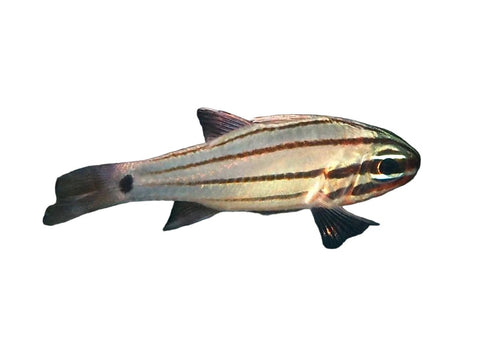
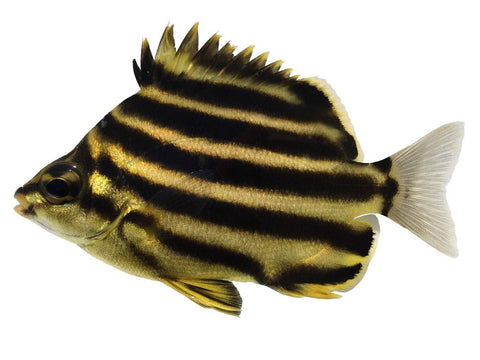
4 Lined Cardinal
$30.00

Every fish passes through our dedicated quarantine system and strict biosecurity monitoring before sale - so it arrives healthy, settled and ready to thrive. How we quarantine →
| Tasmania | YES |
| Western Australia | YES |
| Northern Territory | NO |
| All Other States | YES |
The Blue Arrowhead Soapfish (Belonoperca chabanaudi) is a rare and highly unusual marine fish from the Serranidae family. It is also known simply as the Arrowhead Soapfish or Chabanaud's Soapfish. The species is recognised by its distinctive arrow-shaped body profile, large mouth and attractive pale-to-bluish coloration. The species is documented in Australian Coral Sea fishery records under the name Blue Arrowhead Soapfish.
Unlike the brightly coloured reef fish commonly seen in the aquarium trade, this is a more unusual predatory species. Its large mouth allows it to consume surprisingly substantial prey, so tank mates should be selected carefully.
Provide plenty of live rock, caves and shaded areas where the fish can retreat. Although it can be shy initially, a settled specimen can become a confident and fascinating feature fish.
An important consideration with all soapfish is their ability to produce soap-like toxins (grammistins) when severely stressed or threatened. For this reason, avoid placing them with aggressive fish and take care when transporting or handling them.
It may be kept in a reef environment with caution, but its predatory nature means small fish, shrimp and other small crustaceans may be at risk.
It is a carnivore and should be offered appropriately sized marine meaty foods, including prawns, shrimp, squid, fish-based foods and quality frozen preparations.
Yes. Its large mouth and predatory feeding behaviour mean small fish and ornamental shrimp can potentially become prey.
It is not necessarily highly aggressive toward similarly sized fish, but it is a predator and should not be treated like a typical peaceful community reef fish.
Soapfish can release defensive compounds known as grammistins into the surrounding water when severely stressed. This is an important consideration when transporting or housing them.
Yes. Caves, overhangs and rockwork provide important shelter and allow the fish to establish a secure territory.
Livestock is dispatched with heat/cool packs and oxygen from our Melbourne facility, timed for the safest transit. Live arrivals may be scheduled for the best shipping window. A live arrival guarantee applies - contact us within the required window if anything is not right.
We stand behind everything we sell. If something is not right, get in touch and we will make it right. See our returns policy for the details.
This fish has been through our dedicated quarantine system and is feeding, settled and health-checked before sale. We still recommend acclimating slowly and quarantining new additions at home. Our team is happy to talk you through the right setup - just ask.
Choose type