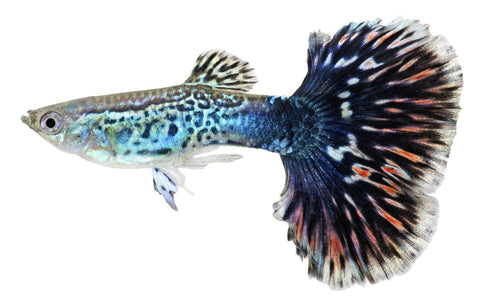
Assorted Guppy
From $7.00
Choose gender

Every fish passes through our dedicated quarantine system and strict biosecurity monitoring before sale - so it arrives healthy, settled and ready to thrive. How we quarantine →
| Tasmania | NO |
| Western Australia | NO |
| Northern Territory | NO |
| All Other States | YES |
The Firecracker Swordtail (Xiphophorus hellerii) is a vibrant freshwater livebearer prized for its fiery combination of red, orange and yellow colouration, often accented by contrasting dark markings. Its bright appearance and active swimming make it an eye-catching addition to a colourful freshwater community aquarium.
The Swordtail originates from Central America and parts of southern Mexico, where wild populations inhabit streams, rivers and other freshwater environments with vegetation and plenty of swimming space. Firecracker is a selectively bred ornamental colour variety rather than a separate species, so individual fish can vary in their patterning and colour intensity.
Male Swordtails are particularly recognisable by the elongated lower ray of their tail fin, which forms the characteristic sword-like extension. Females generally have a rounded tail without this extension and often grow larger-bodied than males. Their vivid colours look especially striking against green plants and darker aquarium backgrounds.
Firecracker Swordtails are active, generally peaceful fish that spend much of their time swimming through the middle and upper levels of the aquarium. They are livebearers, meaning females give birth to free-swimming young rather than laying eggs.
An aquarium of around 80 litres or larger is a practical starting point for a small group, with a longer tank preferred to provide plenty of swimming space. Add live plants around the edges, open swimming areas and some sheltered spots where females and young fish can retreat.
Males may chase females persistently, particularly when several males are kept together. If keeping a mixed-sex group, a ratio of approximately one male to two or three females can help distribute attention. A larger aquarium with plenty of cover is beneficial.
Firecracker Swordtails are omnivores and readily accept quality tropical flakes and small pellets. Supplement their diet with frozen or live foods such as brine shrimp and daphnia, along with suitable vegetable-based foods containing spirulina.
A varied diet supports healthy growth, body condition and vibrant red-orange colouration. Feed small portions once or twice daily, ensuring food is consumed promptly and removing leftovers to maintain water quality.
Firecracker Swordtails generally suit peaceful community aquariums containing similarly sized fish with compatible water requirements. Suitable companions may include platies, mollies, peaceful rainbowfish and appropriately sized tetras. Avoid aggressive fish and species that may nip their fins.
These fish are prolific breeders under suitable conditions. Dense plants such as Java moss can provide shelter for fry, although adult fish may eat their young. If raising fry is a priority, consider a separate nursery aquarium.
Maintain stable water parameters, effective filtration and regular partial water changes. Swordtails generally prefer neutral to alkaline water and can be sensitive to prolonged poor water quality. With adequate space, a balanced diet and compatible tankmates, Firecracker Swordtails make a colourful and rewarding addition to a freshwater community aquarium.
|
Care requirement |
Details |
|---|---|
|
Scientific name |
Xiphophorus hellerii |
|
Common names |
Firecracker Swordtail, Firecracker Swordtail Fish |
|
Family |
Poeciliidae |
|
Origin |
Central America and southern Mexico |
|
Care level |
Easy |
|
Adult size |
Approximately 8–12 cm; males include the sword extension |
|
Minimum aquarium size |
Around 80 litres for a small group |
|
Temperature |
22–28°C |
|
pH |
7.0–8.0 |
|
General hardness (GH) |
Approximately 10–25 dGH |
|
Diet |
Omnivore |
|
Temperament |
Generally peaceful; males may chase one another and females |
|
Swimming level |
Middle and upper levels |
|
Social requirements |
Mixed groups benefit from more females than males |
|
Compatibility |
Peaceful community fish that prefer similar water conditions |
|
Aquarium type |
Freshwater tropical community aquarium |
|
Lifespan |
Approximately 3–5 years with good care |
|
Special requirements |
Stable water quality, swimming space and cover for fry |
Care figures are general guidelines for Xiphophorus hellerii. Individual size and colouration vary between selectively bred strains.
They generally reach around 8–12 cm, including the male's elongated tail extension. Females often have a larger, fuller body than males.
Males develop a distinctive sword-shaped extension on the lower part of the tail fin and have a modified anal fin called a gonopodium. Females lack the sword extension and have a fan-shaped anal fin.
Yes. They are generally hardy, easy to feed and adaptable when kept in a properly cycled aquarium with suitable water conditions.
They accept tropical flakes, small pellets, frozen or live foods and vegetable-based foods. A varied diet helps support healthy growth and vibrant colours.
Yes. Platies and Mollies can make suitable companions when their water requirements and adult sizes are compatible. Monitor males for chasing and aggression.
Yes. They are livebearers and can produce fry regularly in suitable conditions. Provide dense plants for shelter, as adult fish may eat newborn fry.
1. Keeping too many males together: Male Swordtails may chase and compete with one another. Maintain a suitable group and provide enough space and cover.
2. Keeping too few females with a male: Persistent mating behaviour can stress individual females. A mixed-sex group generally benefits from a higher proportion of females.
3. Providing unsuitable water conditions: Swordtails generally prefer neutral to alkaline water with moderate to high hardness. Avoid sudden changes and maintain stable conditions.
4. Feeding only one type of food: A varied omnivorous diet is preferable to flakes alone. Include suitable plant-based and animal-based foods.
5. Ignoring the possibility of breeding: Fry may appear unexpectedly in a mixed-sex aquarium. Provide plant cover or plan for the additional stocking if young fish survive.
6. Overlooking aquarium size: Their active swimming and adult size require sufficient space. Choose a longer aquarium with room for the group to move freely.
Livestock is dispatched with heat/cool packs and oxygen from our Melbourne facility, timed for the safest transit. Live arrivals may be scheduled for the best shipping window. A live arrival guarantee applies - contact us within the required window if anything is not right.
We stand behind everything we sell. If something is not right, get in touch and we will make it right. See our returns policy for the details.
This fish has been through our dedicated quarantine system and is feeding, settled and health-checked before sale. We still recommend acclimating slowly and quarantining new additions at home. Our team is happy to talk you through the right setup - just ask.
Choose gender
Choose size