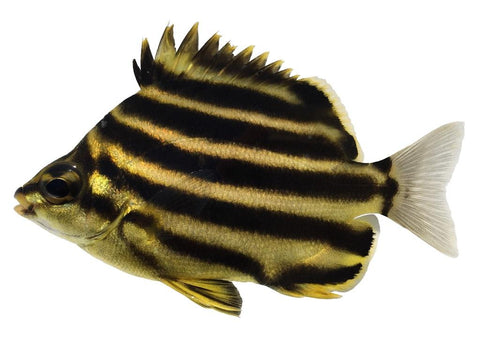
4 Lined Cardinal
$30.00

Every fish passes through our dedicated quarantine system and strict biosecurity monitoring before sale - so it arrives healthy, settled and ready to thrive. How we quarantine →
| Tasmania | YES |
| Western Australia | YES |
| Northern Territory | NO |
| All Other States | YES |
The Mono Argentus (Monodactylus argenteus), also known as the Silver Moony or Silver Mono, is an attractive and highly active fish recognised for its distinctive diamond-shaped body, shimmering silver colouration and striking black vertical markings. Belonging to the family Monodactylidae, this species is popular among aquarists looking for an unusual schooling fish for larger brackish and marine aquariums.
Native to the Indo-West Pacific, including Australia, Indonesia, Southeast Asia and the Red Sea, Mono Argentus inhabit coastal environments such as mangrove forests, tidal creeks, estuaries, harbours and sheltered reefs. They are highly adaptable to changing salinity and can naturally be found in freshwater, brackish and fully marine environments. Juveniles are particularly common in estuaries and freshwater-influenced habitats, while adults are more commonly associated with brackish and marine conditions.
Mono Argentus have a distinctive, laterally compressed diamond-shaped body with a bright metallic silver finish. Two prominent dark vertical bands cross the front portion of the body, one passing through the eye and another behind the gill cover. Their dorsal, anal and tail fins can display attractive yellow colouring, particularly in younger specimens.
As they mature, their body becomes deeper and more rounded, with adult fish developing a more streamlined silver appearance. They are fast, confident swimmers that naturally form large schools, creating an impressive display when maintained in suitable groups.
Aquarium Suitability and Compatibility
Mono Argentus are best suited to large brackish or marine aquariums with plenty of open swimming space. Their active schooling behaviour and eventual adult size mean they are not suitable for small aquariums.
One of the most important considerations when keeping this species is salinity. Juveniles can tolerate freshwater and lower-salinity brackish environments, but they naturally move towards higher salinity as they mature. Adults can be maintained in marine conditions.
For long-term care, a high-brackish to marine environment is generally recommended, with any salinity changes made gradually.
They are semi-aggressive but generally coexist well with other robust fish of similar size. Suitable companions may include Scats, Archerfish, larger brackish-water gobies and appropriately selected marine community fish.
Mono Argentus are not suitable tank mates for very small fish or delicate species that may be intimidated by their constant activity.
Mono Argentus are omnivores and naturally feed on plankton, small invertebrates, algae and organic material.
In captivity, they readily accept a wide variety of prepared and frozen foods, including:
Quality omnivore pellets.
Marine and tropical flakes.
Frozen brine shrimp.
Mysis shrimp.
Chopped prawns and seafood.
Spirulina-based foods.
Nori and other marine algae.
Vegetable-based aquarium foods.
A varied diet containing both plant and animal matter is important for maintaining good condition and healthy growth.
Feed once or twice daily, providing enough food for the entire group without compromising water quality.
A large aquarium with excellent filtration is essential. Mono Argentus are active swimmers and produce considerable waste, particularly when maintained in groups and fed regularly.
Provide a long aquarium with substantial open swimming areas, good water movement and stable water conditions. They are particularly impressive when kept in groups of five or more, which helps encourage natural schooling behaviour.
Because their salinity requirements can change throughout their development, it is important to establish the current water conditions of the fish before introducing them into an aquarium.
With adequate space, appropriate salinity and a balanced diet, Mono Argentus make an impressive addition to large brackish or marine community aquariums.
Species Information
|
Care Requirement |
Details |
|---|---|
|
Common Name |
Mono Argentus / Silver Moony |
|
Scientific Name |
Monodactylus argenteus |
|
Family |
Monodactylidae |
|
Origin |
Indo-West Pacific |
|
Australian Distribution |
Northern and coastal Australia |
|
Care Level |
Moderate to Advanced |
|
Adult Size |
Up to 25–27 cm |
|
Minimum Aquarium |
570 litres recommended |
|
Temperature |
24–28°C |
|
pH |
7.8–8.5 |
|
Specific Gravity |
Variable; approximately 1.008–1.025+ depending on life stage |
|
Diet |
Omnivore |
|
Temperament |
Semi-aggressive |
|
Swimming Level |
Mid-level / Open water |
|
Reef Compatibility |
Not recommended |
|
Aquarium Type |
Brackish / Marine |
|
Social Behaviour |
Schooling; groups of 5+ recommended |
Recommended Aquarium Setup
Large aquarium with plenty of open swimming space.
Keep in groups of five or more where possible.
Strong biological and mechanical filtration.
Good water movement and oxygenation.
Stable salinity appropriate to the fish's life stage.
Compatible, robust community tank mates.
Salinity is not a fixed species-wide requirement. Juveniles and adults naturally occupy different salinity environments. Adult size and aquarium volume recommendations should account for their schooling behaviour and active swimming habits.
1. Are Mono Argentus freshwater or saltwater fish?
Mono Argentus are naturally found in freshwater, brackish and marine environments. Juveniles commonly inhabit freshwater-influenced estuaries, while adults generally move towards higher-salinity brackish and marine environments. They are best considered a brackish-to-marine species for long-term aquarium planning.
2. How big do Mono Argentus grow?
They can reach approximately 25–27 cm, making them a substantial aquarium fish. Their adult size and schooling behaviour should be considered before purchasing.
3. Can Mono Argentus live in freshwater?
Juveniles can tolerate freshwater conditions, particularly when the water is appropriately mineralised. However, freshwater should not automatically be assumed suitable for their entire lifespan. Long-term care should account for their natural movement towards higher salinity as they mature.
4. Should Mono Argentus be kept in groups?
Yes. They are naturally schooling fish and are best maintained in groups of five or more, provided the aquarium is large enough to accommodate them.
5. What do Mono Argentus eat?
They are omnivores and accept a varied diet of quality pellets, flakes, frozen brine shrimp, mysis shrimp, chopped seafood, spirulina and marine algae.
6. Can Mono Argentus live with other fish?
Yes. They are suitable for larger brackish and marine community aquariums containing robust fish of compatible size. Avoid very small fish, delicate species and slow-moving tank mates that may struggle with their active behaviour.
1. Keeping them in small aquariums: Mono Argentus grow considerably larger than their juvenile appearance suggests and require substantial swimming space.
2. Keeping them individually: They are naturally schooling fish and generally display better behaviour when maintained in appropriate groups.
3. Ignoring changing salinity requirements: Their natural habitat changes throughout their development. Juvenile freshwater tolerance does not mean adults should automatically be kept in freshwater.
4. Changing salinity too quickly: Rapid changes can cause significant stress. Always acclimate gradually when transitioning between different salinity environments.
5. Providing an inadequate diet: Feeding only standard flakes or pellets does not provide the dietary variety these omnivores benefit from.
6. Underestimating their filtration requirements: Active schooling fish produce considerable waste. Strong filtration, good oxygenation and regular maintenance are essential.
Livestock is dispatched with heat/cool packs and oxygen from our Melbourne facility, timed for the safest transit. Live arrivals may be scheduled for the best shipping window. A live arrival guarantee applies - contact us within the required window if anything is not right.
We stand behind everything we sell. If something is not right, get in touch and we will make it right. See our returns policy for the details.
This fish has been through our dedicated quarantine system and is feeding, settled and health-checked before sale. We still recommend acclimating slowly and quarantining new additions at home. Our team is happy to talk you through the right setup - just ask.
Choose type