Sale
Sold out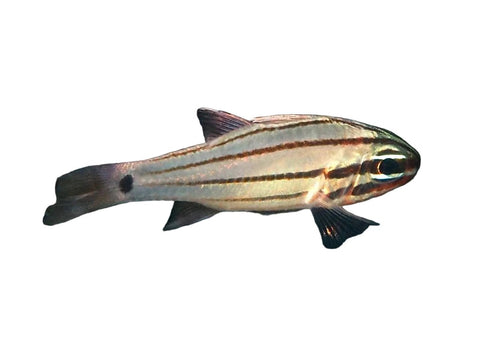
4 Lined Cardinal
$21.00
$30.00

Every fish passes through our dedicated quarantine system and strict biosecurity monitoring before sale - so it arrives healthy, settled and ready to thrive. How we quarantine →
| Tasmania | YES |
| Western Australia | YES |
| Northern Territory | NO |
| All Other States | YES |
The Mystery Wrasse (Pseudocheilinus ocellatus), also known as the Five-Barred Wrasse or Whitebarred Wrasse, is a highly sought-after marine fish recognised for its unusual combination of purple, reddish-pink, yellow and blue markings.
Native to the Indo-Pacific, including Australia's Great Barrier Reef and the Cocos (Keeling) Islands, this species inhabits deeper reef environments where it spends much of its time hunting small invertebrates among coral rubble and rocky crevices.
Its body features distinctive fine white vertical markings across a reddish-purple background, a colourful yellow face with pink and blue markings, and a prominent dark eyespot near the base of its tail.
Mystery Wrasses are naturally secretive when first introduced but become more confident once settled. They are active hunters that constantly inspect live rock for small crustaceans, worms and other invertebrates.
Although relatively small, they can become surprisingly territorial, particularly towards other wrasses and similarly shaped fish. They are best kept as a single specimen in most home aquariums.
The Mystery Wrasse is considered reef compatible, as it generally leaves corals alone. However, it may prey on small ornamental shrimp and other desirable invertebrates. It can also help control unwanted pests such as flatworms and pyramidellid snails.
Provide plenty of mature live rock with caves and shaded crevices. Unlike many other wrasses, this species does not bury itself in sand to sleep, instead retreating into rockwork for shelter.
|
Care Requirement |
Details |
|---|---|
|
Scientific Name |
Pseudocheilinus ocellatus |
|
Family |
Labridae |
|
Origin |
Indo-Pacific, including Australia |
|
Care Level |
Moderate |
|
Maximum Size |
Approximately 11–13 cm |
|
Minimum Aquarium |
250–280 litres recommended |
|
Temperature |
24–27°C |
|
pH |
8.1–8.4 |
|
Salinity |
1.023–1.026 SG |
|
Diet |
Carnivore |
|
Temperament |
Semi-aggressive |
|
Swimming Level |
Middle and lower levels |
|
Reef Compatible |
Yes, with caution around small invertebrates |
|
Aquarium Type |
Marine reef and fish-only |
|
Special Requirements |
Secure lid and established live rock |
1. How big does a Mystery Wrasse grow?
Mystery Wrasses can reach approximately 11 cm, with some references reporting slightly larger specimens. They are active fish that need plenty of swimming space and rockwork.
2. Are Mystery Wrasses reef safe?
Yes, they are generally reef safe and do not normally damage corals. However, they may eat small ornamental shrimp, tiny crabs and other small invertebrates.
3. What do Mystery Wrasses eat?
They are carnivores and enjoy mysis shrimp, enriched brine shrimp, finely chopped seafood, krill and quality marine pellets. They also naturally hunt small invertebrates among live rock.
4. Can Mystery Wrasses be kept with other wrasses?
Caution is recommended. They can become territorial towards other wrasses, particularly similar-looking species and members of their own genus. Keeping a single specimen is generally recommended.
5. Do Mystery Wrasses need a sand bed?
No. Unlike many wrasses, Mystery Wrasses do not bury themselves in sand to sleep. They retreat into caves, crevices and sheltered areas within the live rock.
6. Will a Mystery Wrasse jump out of the aquarium?
Yes. They are capable jumpers, particularly when startled. A secure, tightly fitted aquarium lid or mesh cover is essential.
Keeping them with small ornamental shrimp: Mystery Wrasses naturally hunt small crustaceans and may eat ornamental shrimp.
Keeping multiple wrasses in a small aquarium: They can become territorial and aggressive towards similar species.
Not providing enough live rock: They need caves and crevices for security and sleeping.
Leaving the aquarium uncovered: They are capable jumpers and can escape through surprisingly small gaps.
Introducing them with very timid fish: Their territorial behaviour can cause stress for shy tankmates.
Assuming they are completely peaceful because of their size: Despite their relatively small adult size, they can become dominant and aggressive once established.
Livestock is dispatched with heat/cool packs and oxygen from our Melbourne facility, timed for the safest transit. Live arrivals may be scheduled for the best shipping window. A live arrival guarantee applies - contact us within the required window if anything is not right.
We stand behind everything we sell. If something is not right, get in touch and we will make it right. See our returns policy for the details.
This fish has been through our dedicated quarantine system and is feeding, settled and health-checked before sale. We still recommend acclimating slowly and quarantining new additions at home. Our team is happy to talk you through the right setup - just ask.