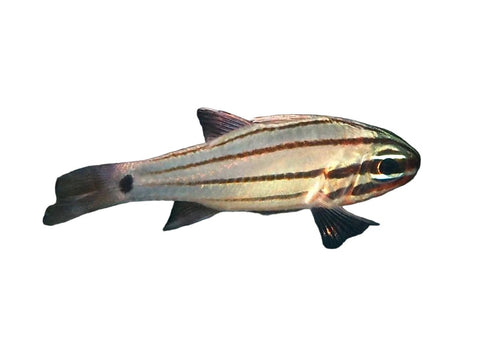
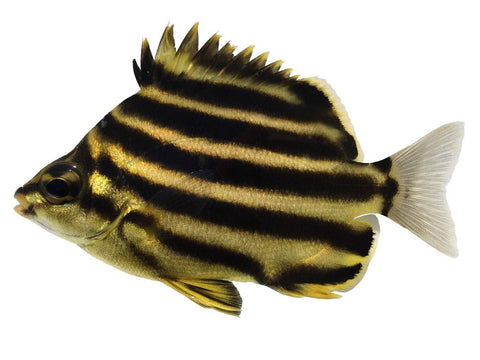
4 Lined Cardinal
$30.00

Every fish passes through our dedicated quarantine system and strict biosecurity monitoring before sale - so it arrives healthy, settled and ready to thrive. How we quarantine →
| Tasmania | YES |
| Western Australia | YES |
| Northern Territory | NO |
| All Other States | YES |
The Silver Scat is a hardy and adaptable brackish-water fish recognised for its silvery body, rounded shape and subtle darker spotting. It is a popular choice for brackish aquariums and can tolerate a wide range of salinities.
Silver Scats are active, social fish that are best kept in groups. They spend much of their time swimming through the middle and lower levels of the aquarium and exploring their surroundings.
As they mature, Silver Scats can become relatively large and require a spacious aquarium. They are primarily herbivorous but will also consume a variety of meaty and prepared foods.
A key consideration with Scats is that their venomous dorsal and anal spines can deliver a painful sting, so care should always be taken when handling or catching them.
Scientific Name: Scatophagus argus
Common Name: Silver Scat / Spotted Scat
Family: Scatophagidae
Type: Brackish Fish / Scatfish
Adult Size: Approximately 25–30 cm
Temperament: Peaceful / Social
Care Level: Easy to Intermediate
Minimum Aquarium: 300 L+
Temperature: 24–28°C
pH: 7.5–8.5
Salinity: Freshwater to Brackish / Marine as adults
Diet: Omnivore / Herbivore
Tank Level: Midwater
Reef Safe: No
Suitable For: Brackish aquariums and large fish-only systems
Juveniles can tolerate freshwater, but Silver Scats naturally occur across freshwater, brackish and marine environments. As they mature, they generally do best with increasing salinity.
They can reach approximately 25–30 cm, so a large aquarium is required for adult specimens.
They are social fish and generally do best when kept in a group of several individuals.
They are omnivores with a strong preference for plant matter. Offer marine algae, Spirulina, vegetables, quality pellets and suitable frozen foods.
No. They are not suitable for reef aquariums and may eat or damage plants and other delicate organisms.
Keeping them permanently in freshwater without a plan for adult care
While juveniles can tolerate freshwater, their long-term requirements should be considered as they mature.
Keeping only one fish
Scats are social and generally do better in groups.
Using an undersized aquarium
They become large, active fish and produce a significant amount of waste.
Ignoring their venomous spines
Their dorsal, anal and pelvic spines can cause a very painful sting. Handle them carefully.
Not allowing for increasing salinity
Research the intended long-term setup before purchasing juveniles.
Livestock is dispatched with heat/cool packs and oxygen from our Melbourne facility, timed for the safest transit. Live arrivals may be scheduled for the best shipping window. A live arrival guarantee applies - contact us within the required window if anything is not right.
We stand behind everything we sell. If something is not right, get in touch and we will make it right. See our returns policy for the details.
This fish has been through our dedicated quarantine system and is feeding, settled and health-checked before sale. We still recommend acclimating slowly and quarantining new additions at home. Our team is happy to talk you through the right setup - just ask.
Choose type