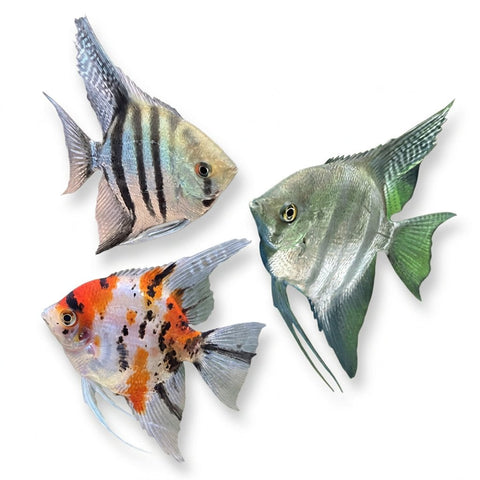
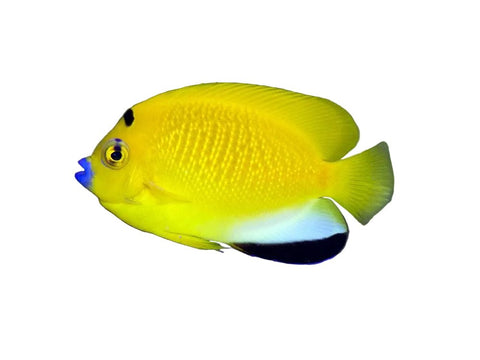
Assorted Angelfish
From $12.00
Choose size

Every fish passes through our dedicated quarantine system and strict biosecurity monitoring before sale - so it arrives healthy, settled and ready to thrive. How we quarantine →
| Tasmania | YES |
| Western Australia | YES |
| Northern Territory | NO |
| All Other States | YES |
The Koran Angel (Pomacanthus semicirculatus), also known as the Semicircle Angelfish or Half-Circled Angelfish, is a spectacular large marine angelfish prized for its impressive size, distinctive markings and dramatic transformation as it matures. Native to the Indo-West Pacific, including parts of Australia, Indonesia, the Red Sea and the wider Indo-Pacific, this species inhabits coastal reefs, lagoons and rocky environments where it grazes on sponges, tunicates and algae.
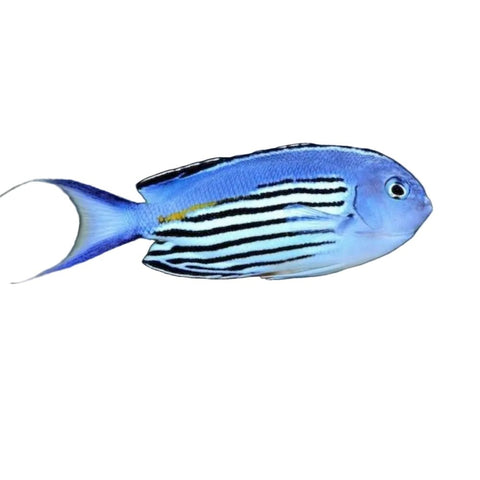
One of the most fascinating features of the Koran Angel is its dramatic colour transformation throughout its life. Juveniles display a striking dark blue to almost black body covered in beautiful curved white and electric-blue semicircular stripes. As the fish matures, these markings gradually disappear, developing into an attractive greenish-yellow and brown body covered in small blue spots, with vivid blue edging around the fins and distinctive elongated dorsal and anal fin extensions.
Koran Angels are active, confident swimmers that spend much of their time exploring rockwork, grazing on surfaces and investigating their surroundings. Juveniles can initially be relatively shy, particularly when introduced to a new aquarium, but adults generally become much bolder and can develop territorial behaviour as they mature.
Aquarium Suitability and Compatibility
The Koran Angel is best suited to large, established fish-only-with-live-rock (FOWLR) aquariums. With an adult size reaching approximately 40 cm, this species requires considerable swimming space, excellent filtration and plenty of mature live rock.
Although juveniles may initially leave corals alone, Koran Angels should not be considered reef safe. Their natural feeding behaviour involves grazing on sponges and other sessile invertebrates, and they may nip at soft corals, LPS corals, SPS corals, zoanthids and clam mantles. They are therefore unsuitable for aquariums containing valuable corals or delicate invertebrates.
Their temperament is generally semi-aggressive, with territorial behaviour becoming more pronounced as they grow. They are best housed with other robust marine fish of compatible size, such as larger tangs, rabbitfish, wrasses and selected triggerfish. Avoid keeping them with timid species, small delicate fish or similarly shaped angelfish unless the aquarium is exceptionally large.
Feeding and Nutrition
Koran Angels are omnivores and require a varied, nutritionally balanced diet to maintain their health, growth and colouration. In the wild, they feed on marine sponges, tunicates, algae and other small organisms found around reef structures.
In captivity, offer a combination of:
High-quality marine angelfish preparations containing sponge.
Frozen mysis shrimp and enriched brine shrimp.
Chopped prawns, mussels and other marine seafood.
Marine algae and nori.
Spirulina-based foods and quality marine pellets.
Vitamin-enriched frozen foods.
Providing multiple smaller meals throughout the day is beneficial, particularly for younger specimens. A varied diet containing both marine-based proteins and vegetable matter is essential for long-term health.
Aquarium Requirements
A mature aquarium with stable water parameters is essential for keeping a Koran Angel successfully. Provide extensive live rock, caves, overhangs and sheltered areas where the fish can retreat, alongside plenty of unobstructed swimming space.
Due to its eventual size and feeding requirements, strong biological filtration, efficient protein skimming and regular maintenance are important. Avoid introducing this species into newly established aquariums.
The Koran Angel is an impressive long-term addition for experienced marine aquarists with the space and facilities to accommodate its adult requirements.
Species information
|
Care requirement |
Details |
|---|---|
|
Common Name |
Koran Angel |
|
Scientific Name |
Pomacanthus semicirculatus |
|
Family |
Pomacanthidae |
|
Origin |
Indo-West Pacific |
|
Care Level |
Moderate to Advanced |
|
Adult Size |
Up to 40 cm |
|
Minimum Aquarium |
1,000 litres |
|
Temperature |
24–27°C |
|
pH |
8.1–8.4 |
|
Specific Gravity |
1.023–1.026 |
|
Diet |
Omnivore |
|
Temperament |
Semi-aggressive |
|
Swimming Level |
All levels / Active swimmer |
|
Reef Compatibility |
Not reef safe |
|
Aquarium Type |
Fish Only / FOWLR |
|
Social Behaviour |
Best kept singly |
Recommended aquarium setup
Mature marine aquarium with established live rock.
Extensive caves and sheltered hiding spaces.
Large open swimming areas.
Strong biological filtration and protein skimming.
Stable salinity and excellent water quality.
1. Is the Koran Angel reef safe?
No. Koran Angels are not considered reef safe. They naturally graze on sponges and other sessile organisms and may nip at LPS corals, SPS corals, soft corals, zoanthids and clam mantles. A fish-only aquarium is strongly recommended.
2. How big does a Koran Angel grow?
Koran Angels can reach approximately 40 cm in length. Their eventual size should be considered before purchasing, as juveniles grow into substantial adult fish requiring a very large aquarium.
3. Why does my Koran Angel look different from pictures online?
Koran Angels undergo a dramatic colour transformation as they mature. Juveniles have dark bodies with curved blue and white stripes, while adults develop greenish-yellow and brown colouring with blue spots and fin markings. Both appearances are normal stages of development.
4. What should I feed my Koran Angel?
Offer a varied diet including sponge-based angelfish preparations, mysis shrimp, enriched brine shrimp, chopped seafood, marine algae and quality marine pellets. Variety is important for maintaining good health.
5. Can Koran Angels live with other angelfish?
They can become territorial towards other angelfish, particularly species with similar body shapes or appearance. Keeping multiple large angelfish together is best reserved for exceptionally large aquariums with careful species selection and introduction.
6. What size aquarium does a Koran Angel need?
A minimum of approximately 1,000 litres is recommended for long-term adult care. Larger aquariums are preferable, particularly for fully grown specimens, due to their active swimming behaviour and substantial adult size.
1. Keeping them in aquariums that are too small: Juveniles may look comfortable in smaller aquariums, but adults can reach 40 cm and require substantial swimming space.
2. Assuming they are reef safe: Their natural grazing behaviour can result in damage to corals, clams and other reef invertebrates.
3. Feeding an unvaried diet: Relying exclusively on frozen meaty foods or standard marine pellets can result in nutritional deficiencies. Include sponge-based foods and marine algae.
4. Introducing them into immature aquariums: Koran Angels benefit from established biological filtration, mature live rock and stable water conditions.
5. Keeping them with unsuitable tank mates: Small, timid or slow-feeding fish may struggle alongside a large, confident and territorial Koran Angel.
6. Ignoring their adult appearance and size: Many aquarists purchase juveniles because of their attractive striped pattern without planning for their eventual adult size and colour transformation.
Livestock is dispatched with heat/cool packs and oxygen from our Melbourne facility, timed for the safest transit. Live arrivals may be scheduled for the best shipping window. A live arrival guarantee applies - contact us within the required window if anything is not right.
We stand behind everything we sell. If something is not right, get in touch and we will make it right. See our returns policy for the details.
This fish has been through our dedicated quarantine system and is feeding, settled and health-checked before sale. We still recommend acclimating slowly and quarantining new additions at home. Our team is happy to talk you through the right setup - just ask.
Choose size

Choose quantity