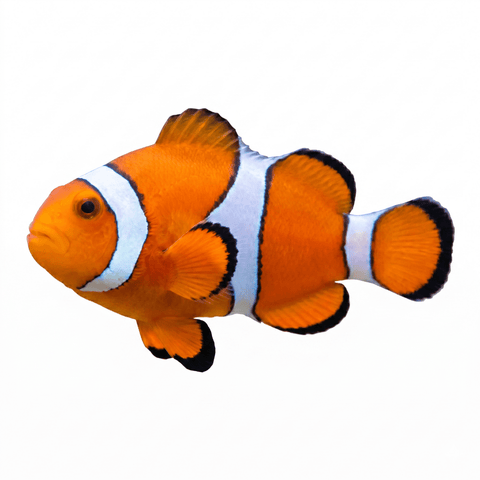
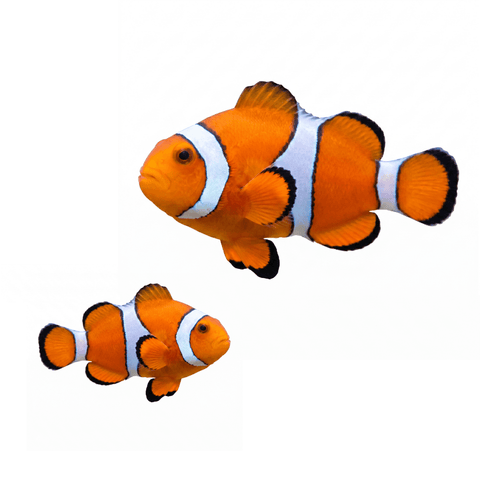
Orange Ocellaris Clown
From $35.00
Choose size

Every fish passes through our dedicated quarantine system and strict biosecurity monitoring before sale - so it arrives healthy, settled and ready to thrive. How we quarantine →
| Tasmania | YES |
| Western Australia | YES |
| Northern Territory | NO |
| All Other States | YES |
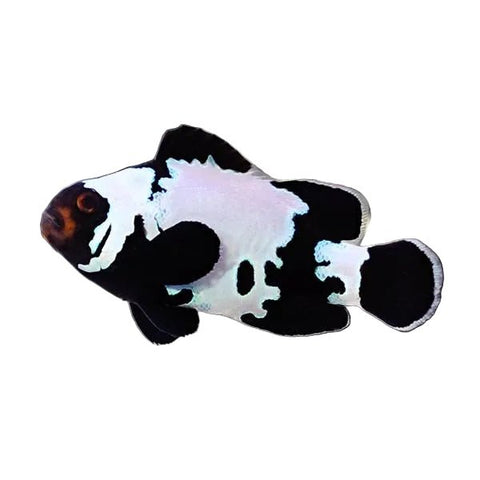
The Black Saddleback Clownfish (Amphiprion polymnus) is a distinctive and highly attractive marine clownfish, recognised for its predominantly dark body and unusual white saddle-shaped markings. Unlike many popular clownfish species with three vertical white bands, the Black Saddleback has a characteristic pattern consisting of a white head band and a broad white marking across the middle of its back, creating its unmistakable saddle-like appearance.
Colouration can vary between individuals and geographic locations. Some specimens display predominantly black bodies with white markings, while others may have brown or orange colouring, particularly around the face and fins. This natural variation makes the species particularly interesting for marine aquarium enthusiasts.
Native to the Indo-West Pacific, including northern Australia, Indonesia, Papua New Guinea and surrounding regions, Black Saddleback Clownfish inhabit sheltered coastal reefs, lagoons and sandy reef environments. They are commonly associated with particular sea anemones, especially Stichodactyla haddoni and Heteractis crispa.
Behaviour and Temperament
Black Saddleback Clownfish are active, confident fish that can develop strong territorial behaviour, particularly once established as a breeding pair. They are generally peaceful towards appropriately selected community fish but will defend their chosen territory, host anemone or nesting site.
They are best kept as a compatible pair. Like other clownfish, they are protandrous hermaphrodites, meaning individuals begin life as males, with the dominant fish capable of transitioning into a female. Females are typically larger than males.
Aquarium Suitability and Compatibility
Black Saddleback Clownfish are suitable for established marine reef aquariums and fish-only systems. They are considered reef safe with corals, although caution is recommended when keeping them with small ornamental shrimp and other vulnerable invertebrates.
In their natural environment, they form symbiotic relationships with particular sea anemones, especially:
Haddon's Carpet Anemone (Stichodactyla haddoni).
Sebae Anemone (Heteractis crispa).
Long Tentacle Anemone (Macrodactyla doreensis).
An anemone is not essential for their survival in captivity. A well-designed aquarium with suitable rockwork and sheltered areas can provide an appropriate environment without one.
Suitable tank mates include tangs, wrasses, gobies, blennies, cardinalfish and other appropriately sized community reef species. Avoid housing them with aggressive clownfish species or fish likely to harass them.
Feeding and Nutrition
Black Saddleback Clownfish are omnivores and readily accept a variety of prepared aquarium foods. In their natural habitat, they feed on zooplankton, small crustaceans and algae.
For optimal health and colouration, offer a varied diet consisting of:
Frozen mysis shrimp.
Enriched brine shrimp.
Chopped prawns and marine seafood.
Quality marine pellets.
Marine flake foods.
Spirulina-based foods.
Small amounts of marine algae.
Feed one to three small meals daily, ensuring that food is appropriately sized and that both fish in a pair receive adequate nutrition.
Aquarium Requirements
A mature marine aquarium with stable water parameters, established biological filtration and plenty of rockwork is ideal.
Although they naturally associate with anemones, Black Saddleback Clownfish can adapt well to aquariums without a host. Provide suitable hiding places and some open swimming space.
They are relatively hardy once established, making them a rewarding species for aquarists looking for something different from the more commonly available Ocellaris and Percula Clownfish.
Captive-bred specimens are worth considering where available, as they generally adapt well to aquarium conditions.
Species Information
|
Care Requirement |
Details |
|---|---|
|
Common Name |
Black Saddleback Clownfish |
|
Scientific Name |
Amphiprion polymnus |
|
Family |
Pomacentridae |
|
Origin |
Indo-West Pacific |
|
Australian Distribution |
Northern Australia |
|
Care Level |
Moderate |
|
Adult Size |
Up to 13 cm |
|
Minimum Aquarium |
200 litres recommended |
|
Temperature |
24–27°C |
|
pH |
8.1–8.4 |
|
Specific Gravity |
1.023–1.026 |
|
Diet |
Omnivore |
|
Temperament |
Semi-aggressive / Territorial |
|
Swimming Level |
Mid-level / Lower aquarium |
|
Reef Compatibility |
Reef safe |
|
Aquarium Type |
Marine Reef / Fish Only |
|
Social Behaviour |
Best kept as a compatible pair |
Recommended Aquarium Setup
Established marine aquarium with mature biological filtration.
Live rock with caves and sheltered areas.
Open swimming space.
Sandy areas are beneficial.
Compatible anemone optional.
Peaceful to moderately assertive tank mates.
Stable temperature and salinity.
1. Are Black Saddleback Clownfish reef safe?
Yes. They are generally considered reef safe and can be housed with SPS, LPS and soft corals. However, they may occasionally disturb corals if they establish a nesting or hosting territory. Small ornamental shrimp should be monitored.
2. How big do Black Saddleback Clownfish grow?
They can reach approximately 13 cm in length, making them larger than many commonly available clownfish species. Females generally grow larger than males.
3. Do Black Saddleback Clownfish need an anemone?
No. Although they naturally associate with sea anemones, they can live successfully in aquariums without one. Providing suitable rockwork and sheltered areas is important.
4. Can Black Saddleback Clownfish be kept in pairs?
Yes. They are well suited to being kept as a compatible male and female pair. Once established, pairs may become territorial, particularly around their preferred hosting or nesting area.
5. What do Black Saddleback Clownfish eat?
They accept a varied omnivorous diet including mysis shrimp, enriched brine shrimp, chopped seafood, marine pellets, quality flake foods and spirulina-based foods.
6. Are Black Saddleback Clownfish aggressive?
They are generally moderately territorial, particularly as they mature and establish a breeding pair. They can become defensive around their host anemone or nesting site but are usually compatible with appropriately selected marine community fish.
1. Confusing them with standard clownfish: Saddleback Clownfish have a distinctive white saddle marking rather than the three evenly spaced bands seen on many other clownfish species.
2. Keeping them with aggressive clownfish: Mixing different clownfish species can result in territorial disputes and serious aggression.
3. Assuming they require an anemone: A host anemone is not essential. They can thrive in a suitable aquarium without one.
4. Underestimating their adult size: Growing to approximately 13 cm, they need more swimming space than smaller clownfish varieties.
5. Feeding an unvaried diet: Relying exclusively on one type of frozen food can result in nutritional deficiencies. Offer a balanced combination of meaty and algae-based foods.
6. Ignoring territorial behaviour: Established pairs can become defensive, particularly during breeding. Allow sufficient space and avoid overcrowding the aquarium.
Livestock is dispatched with heat/cool packs and oxygen from our Melbourne facility, timed for the safest transit. Live arrivals may be scheduled for the best shipping window. A live arrival guarantee applies - contact us within the required window if anything is not right.
We stand behind everything we sell. If something is not right, get in touch and we will make it right. See our returns policy for the details.
This fish has been through our dedicated quarantine system and is feeding, settled and health-checked before sale. We still recommend acclimating slowly and quarantining new additions at home. Our team is happy to talk you through the right setup - just ask.
Choose size